What we are doing
Replacing the screen with a more interesting body - one that smells flour, hears bubbling, feels heat, tastes salt, sees colour change.
Module 04 · 2 weeks · KS3 / KS4
The grounding, screen-free, physical reality of cooking.
Many of our students arrive holding a phone the way a much younger child holds a teddy bear - not because they are addicted, but because the device has become the most reliable regulating object in their life. We do not begin by taking the phone away. We begin by offering something else for the hands to do.
Module 4 is the quietest module. It is also, statistically, the one that produces the most parental feedback. By the end of two weeks, students are typically tolerating a full phone-free session, noticing their own dysregulation without screen mediation, and reporting better sleep at home.
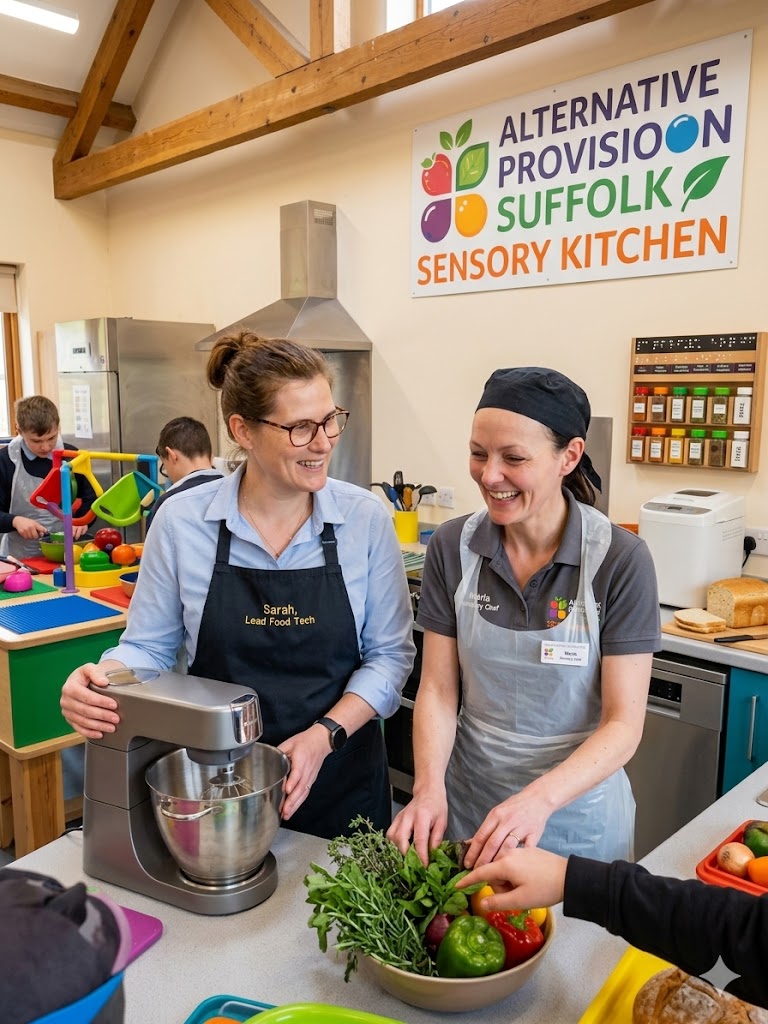
The phone policy
Week 1
Phones are not confiscated. They live in the student’s pocket. We notice - and name - when the phone comes out. We do not police it; we observe it. We start to build awareness.
Week 2 - early
Phones are placed in a labelled basket on the side. The student knows exactly where it is. The student knows they can retrieve it. The retrieval almost never happens once the dough is in the hands.
Week 2 - later
With consent, phones move one room over. The student names how long they can tolerate this. We do not over-state the lesson; we let the body do the teaching.
Always
Any student with a medical alert, a young carer status or a safeguarding sensitivity carries the device on their person regardless of the above. The policy is not a rule. The policy is a tool.
The five-senses protocol
Built around the well-evidenced 5-4-3-2-1 grounding technique, adapted for a kitchen environment and for students who find ‘mindfulness’ language alienating. We call it ‘checking in with the room’.
The protocol is taught explicitly, named, practised, and at the end of placement printed onto a small card the student keeps. Many former students still carry the card.
Why screen-free cooking works
Bilateral, rhythmic, repetitive movement
Kneading, stirring, chopping. The same movement patterns therapists deliberately use to down-regulate an over-aroused nervous system - students do, for hours, accidentally.
Heat, smell, taste - multisensory anchoring
The kitchen is a high-bandwidth sensory environment that the student gets to design and control, not endure. That is a meaningful reversal for anyone with a sensory profile.
Visible, finishable task
In a world of infinite scrolls, a meal has an end. There is a moment when the dish is on the table and the work is done. Many students have not had that feeling in months.
Co-regulation with a calm adult
A regulated nervous system is contagious in the right direction. Our adult-to-student ratios are deliberately tight so that the adults can stay regulated themselves.